
 Cart is empty
The apparel industry is in the middle of one of the most consequential shakeups it has seen in decades, and the timing could not be more fitting for what Nature’s Sunset has built into its clothing line. Regulators across the globe are no longer content to let brands hide behind vague marketing language. Sweeping new rules are forcing manufacturers to prove, with real documentation, that the materials in their products are what they claim to be and that the waste created along the way is being handled responsibly. Against that backdrop, Nature’s Sunset has quietly been doing the work that many companies are only now being forced into, and its Unisex Athletic Shorts stand as one of the clearest examples of that philosophy in action.
This is not a coincidence. It is the result of a brand built from the ground up around the idea that sustainability should be engineered into a garment rather than printed on a tag. As the wider fashion world scrambles to catch up with new expectations, Nature’s Sunset offers a look at what a mature, responsibly built product line already looks like.
A Regulatory Reckoning Is Reshaping the Entire Apparel Industry
To understand why the Unisex Athletic Shorts matter right now, it helps to understand the environment they were built for. The European Union has implemented sweeping new rules under its Ecodesign for Sustainable Products Regulation, and one of the most significant provisions bans large fashion corporations from destroying unsold apparel and footwear outright. Rather than sending excess inventory to a landfill or an incinerator, these companies must now prioritize donating surplus stock for a meaningful stretch of time before disposal becomes an option. It is a direct strike against the wasteful cycle of overproduction that has defined fast fashion for years, and it signals a broader shift in how governments intend to treat clothing waste going forward.
That shift is not limited to what happens after a garment fails to sell. It extends to what garments are made of in the first place. Textile recycling has moved well past the pilot stage and is now scaling into genuine industrial infrastructure. New research and development centers dedicated to textile to textile polyester recycling are opening in the United States, and industry collaboratives focused on fiber innovation are working to make recycled yarns commercially viable at a scale that mainstream brands can actually use. At the same time, next generation bio fabricated materials, once considered a niche luxury concept, are being integrated into mainstream apparel lines as manufacturers look for ways to reduce their dependence on petroleum based virgin synthetics.
Beauty and personal care are experiencing their own version of this reckoning. State legislatures across the country have begun banning the intentional use of certain persistent chemical compounds in cosmetics and personal care products, and multiple states have now enacted full prohibitions. Certification bodies that once granted cruelty free status based on a simple statement from the finished product manufacturer have tightened their standards considerably, now requiring full documented tracing of every ingredient supplier in a product’s chain. Even long trusted names in clean beauty have found themselves under scrutiny after quietly stepping back from vegan formulation commitments they had spent years building. Regulatory frameworks governing cosmetics manufacturing have also matured, granting oversight bodies real authority to penalize brands that use unregulated buzzwords like natural or eco friendly when their actual supply chains cannot support the claim.
The throughline across every one of these developments is the same. The era of taking a brand’s word for it is ending. Consumers, regulators, and watchdog organizations now expect proof, and that proof has to be built into a product from the very beginning rather than bolted on after the fact through a clever label. This is precisely the standard that Nature’s Sunset has held itself to, and the Unisex Athletic Shorts are a direct expression of it.
Engineering Meets Purpose in the Unisex Athletic Shorts
At the center of this feature is a piece of activewear that was designed to do far more than look good on a hanger. The Nature’s Sunset Unisex Athletic Shorts are constructed from a blend of ninety one percent recycled polyester and nine percent spandex, a combination chosen deliberately to give the fabric both structure and give. That recycled polyester content matters enormously in the current climate. Instead of relying on newly extracted petroleum to create synthetic fiber, this fabric diverts existing plastic waste back into a usable, wearable form, directly supporting the same circular economy principles that regulators around the world are now writing into law.
The fabric itself has been engineered for genuine athletic performance rather than simply borrowing the aesthetic of a workout garment. At a weight of just over five ounces per square yard, it strikes a careful balance between durability and breathability. A four way stretch construction allows for a complete range of motion, whether someone is midway through a training session, cooling down after a swim, or simply going about an active day. Moisture wicking microfiber technology pulls sweat away from the skin, while the fast drying nature of the material means the shorts do not stay damp or heavy after intense use, an especially valuable feature for anyone who moves between multiple activities in a single outing.
Sun protection has been built directly into the fabric as well, with a rating that blocks the overwhelming majority of harmful ultraviolet rays. That kind of built in protection is not just a bonus feature. It reflects a design philosophy that treats a garment as something that should actively protect the body, not merely cover it. An elastic waistband paired with a flat white drawstring allows for a fully adjustable, secure fit regardless of body type, which speaks directly to the shorts’ unisex design intention. Mesh side pockets provide practical, breathable storage without adding bulk or weight, and a two and a half inch inseam keeps the silhouette athletic and unrestrictive, equally suited to a run, a swim, or a gym session.
Every one of these specifications was chosen with intention. Nothing about the construction feels like an afterthought, and that consistency is exactly what a genuinely sustainable product should look like in a world where so many companies are being caught making claims their supply chains cannot back up.
Extending the Same Standard to Swimwear with the Recycled High-Waisted Bikini
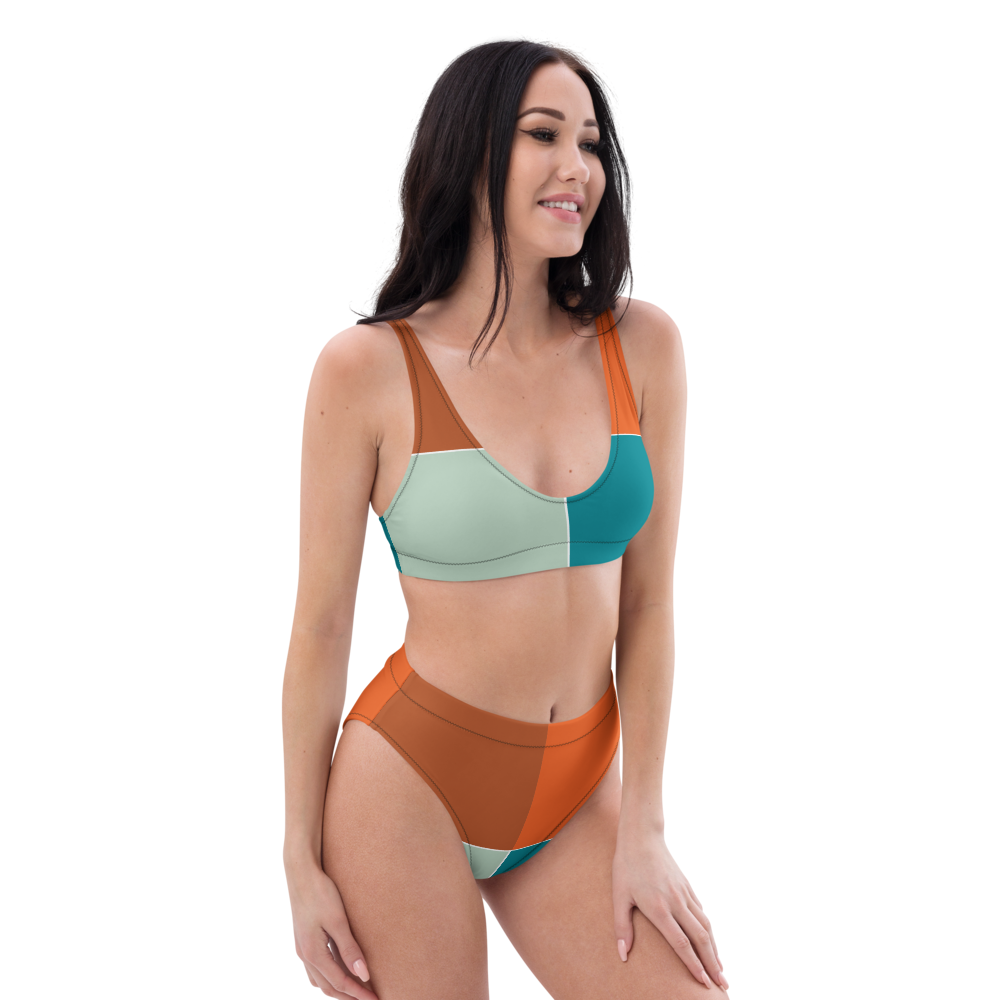
That same engineering mindset carries directly into the Nature’s Sunset swimwear line, where the Recycled High-Waisted Bikini has quickly become one of the brand’s most talked about pieces. It is easy to see why. The set is built with a double layered construction that keeps it comfortable for a full day spent moving between the pool, the sand, and everything in between, and the padding inside is fully removable, giving each wearer the freedom to customize coverage and support to their own preference rather than being locked into a single fixed fit.
The fabric itself changes slightly depending on where it is produced, a detail that reflects just how seriously Nature’s Sunset takes regional sourcing and material accountability. Versions manufactured for the European market are built from a blend of eighty eight percent recycled polyester and twelve percent elastane, coming in at a substantial fabric weight of roughly six and three quarters ounces per square yard, giving the set a supportive, structured hand feel. Versions produced for the United States market lean on a slightly different formulation, built from eighty one percent REPREVE recycled polyester paired with nineteen percent LYCRA XTRALIFE, a combination known throughout the swimwear industry for holding its shape and color against sun, salt water, and chlorine over repeated wear. That version carries a noticeably heavier fabric weight of roughly seven and a half ounces per square yard, giving the American cut a slightly more substantial, long lasting feel suited to frequent, active use.
The construction details reinforce that same commitment to quality over shortcuts. The bikini is non reversible and finished with tidy zig zag stitching along the seams, a small but meaningful choice that improves durability and flexibility compared to a straight stitch, which tends to crack or pop under the stretch that swimwear regularly endures. A tear away care label keeps the finished product free of an irritating tag while still giving the wearer full access to washing instructions before it is removed. Even the sourcing of the blank components before decoration and assembly reflects a global, carefully coordinated supply chain, with materials for the European version originating from Spain, Germany, Taiwan, Vietnam, Cambodia, and Lithuania, and materials for the United States version sourced from Colombia, Taiwan, and China.
That level of sourcing transparency is exactly the kind of documentation that regulators and certification bodies are now beginning to require across the fashion and beauty industries, and it is the same standard Nature’s Sunset already applies to the Unisex Athletic Shorts. Whether someone is training on land or soaking up the sun by the water, the underlying philosophy stays consistent. Recycled material should never come at the expense of genuine performance, comfort, or transparency, and every piece in the Nature’s Sunset collection is built to prove that those things can coexist.
Part of a Larger Commitment Across the Nature’s Sunset Clothing Line
The Unisex Athletic Shorts do not exist in isolation. They are part of a broader recycled clothing collection that Nature’s Sunset has built specifically to give people an alternative to the disposable, petroleum heavy fashion cycle that regulators are now actively working to dismantle. Every piece in that collection is developed with the same underlying commitment to recycled materials, genuine performance value, and a design language that works for real, active bodies rather than a narrow marketing ideal.
This matters because the shorts are meant to function as an entry point into a much larger wardrobe philosophy. Someone who picks up a pair of these shorts for a workout is being introduced to a brand that applies the exact same standard across its long sleeve tops, its swim and athletic separates, and its broader activewear essentials. The consistency across the collection is deliberate. Rather than offering one flagship sustainable product surrounded by conventional, less accountable items, Nature’s Sunset has built its recycled clothing line so that the values embedded in the shorts extend across the entire assortment.
That consistency is also what separates a brand built for this new regulatory era from one that will struggle to keep up with it. As documentation requirements tighten and greenwashing penalties become more common, brands that already have transparent, traceable supply chains will have a considerable advantage over those trying to retrofit accountability into products that were never built with it in mind. Nature’s Sunset has positioned its clothing line, and its athletic shorts in particular, exactly where the market and the regulatory landscape are heading.
Why This Moment Matters for Everyday Shoppers
It would be easy to treat all of this regulatory movement as background noise that only matters to corporate compliance departments, but the reality is that it changes what an everyday consumer should expect from the clothes they buy. A shopper picking up a pair of athletic shorts today has every reason to ask where the fabric came from, what happens to unsold inventory, and whether the sustainability claims on the label can actually be traced back through the supply chain. Those questions are no longer niche concerns reserved for dedicated environmentalists. They are becoming standard due diligence, and rightly so.
Nature’s Sunset built the Unisex Athletic Shorts to hold up under exactly that kind of scrutiny. The recycled polyester content is not a footnote buried in fine print. It is the foundation of the garment, chosen because it reduces reliance on virgin synthetic material at a moment when doing so is becoming a legal expectation rather than a marketing choice. The performance features, from the moisture wicking fabric to the built in sun protection, exist because a genuinely sustainable product should never ask a customer to sacrifice function for the sake of a values driven purchase.
There is also something to be said for the unisex design itself. As the fashion industry works through significant structural change, from unsold inventory rules to material sourcing requirements, a growing number of brands are also rethinking rigid, gendered product lines in favor of designs that work broadly across body types and preferences. The Nature’s Sunset Unisex Athletic Shorts fit naturally into that shift, offering one well engineered design rather than segmenting the same basic garment into narrower, less efficient product lines.
A Brand Built for Where the Industry Is Headed
What makes this moment particularly notable for Nature’s Sunset is the timing. As new textile regulations take effect, as recycling infrastructure scales into genuine industrial capacity, and as certification bodies tighten their standards across both fashion and beauty, brands that already operate at this level of transparency and material integrity are positioned to benefit the most. Nature’s Sunset has spent its history building a clothing line, a beauty range, and a broader collection of home goods and wellness products around exactly the kind of accountability that regulators are now mandating industry wide.
The Unisex Athletic Shorts represent that philosophy in one of its most practical, everyday forms. They are not a limited edition sustainability statement piece meant to sit unused in a drawer. They are a functional, well constructed piece of activewear that happens to be built from recycled material, engineered for genuine performance, and priced for everyday accessibility at just under forty dollars. That combination, real performance value delivered through a transparent, recycled construction, is precisely what the next era of apparel is going to demand from every brand competing in this space.
Anyone looking to update their activewear rotation with something that reflects where the industry, and the regulations governing it, are clearly headed would be well served by giving the Nature’s Sunset Unisex Athletic Shorts a closer look, along with the rest of the recycled clothing collection built around the same set of standards. As the rules around sustainability claims continue to tighten across the fashion and beauty industries alike, having a wardrobe built on genuine transparency rather than a well worded label is quickly becoming less of a luxury and more of a baseline expectation, and Nature’s Sunset has been building toward that baseline all along.